Industrial-grade garage floor
A poured epoxy floor for a home garage, a commercial garage or a workshop
An industrial-grade garage floor is a poured epoxy layer about 1 mm thick, applied over the existing concrete: Sikafloor-151 primer, two coats of Sikafloor-264 epoxy and a broadcast of quartz sand. The sealed surface doesn’t dust, salty water and oil from the car can’t soak into the concrete, and the floor can be washed. For a guide price from our price list in Slovakia, choose the floor type and enter your area in the quote configurator.
+421 948 143 981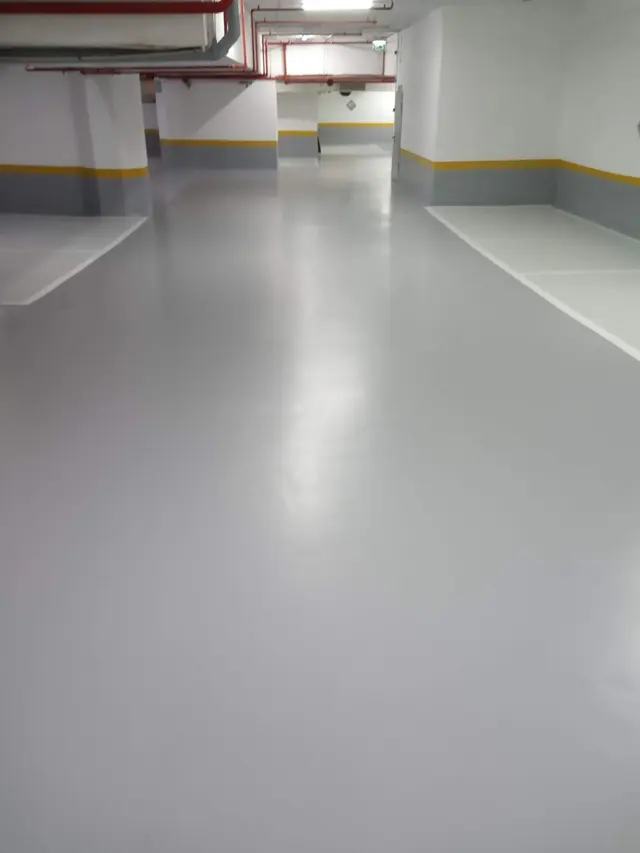
Work out your price per m²
For a guide price in euros, based on our price list in Slovakia, choose your floor type and enter your area in the quote configurator.
Calculate the price for my areaWhat “industrial-grade” means for a garage floor
A garage gets the same epoxy build-up we lay in workshops and commercial premises, not just a thin roller-applied coating. The Sikafloor-264 technical data sheet also lists garages among the places this epoxy is intended for. The surface stands up to abrasion and to cars driving over it.
The epoxy comes in two thicknesses. The 1 mm layer levels out minor unevenness and is the most common choice for garages. The 2 mm layer hides larger unevenness too and belongs in workshops, commercial premises and industry, where the load is higher. Which one suits your concrete is decided after a site survey, where we check moisture, strength, cracks and movement joints.
A factory or warehouse with forklifts, or a floor with an additional layer such as ESD or ATEX, is specified separately. Epoxy, polyurethane and combined systems with a quartz broadcast are described on the industrial flooring page.
Build-up of an epoxy garage floor
The first step is grinding the concrete with a diamond grinder that extracts the dust as it goes, followed by thorough vacuuming. We fill cracks and construction joints; over the slab’s movement joints we leave a gap in the epoxy and fill it with flexible sealant.
The times in the table apply at +20 °C.
| Layer | Material | Consumption | Next layer |
|---|---|---|---|
| Primer | Sikafloor-151 | approx. 0.4 kg/m² | after about 12 hours |
| Main layer in two coats | Sikafloor-264 | approx. 1.5 kg/m² | second coat after 24 hours at the earliest |
| Anti-slip broadcast | quartz sand | approx. 1 kg/m² | final layer, broadcast into the wet second coat |
Salt, water and oil from cars
In winter, snow laden with road salt melts off the car in the garage. The epoxy layer keeps water away from the concrete, so the salty puddle stays on top and only needs wiping up or washing away.
With petrol, engine oil or brake fluid, time is what matters. Sikafloor-264 epoxy copes with a spill you wipe up straight away, but liquid left on the floor for longer can change the colour or gloss of the surface, and petrol will attack it over time. So don’t leave drips under the car sitting on the floor for days.
Warm tyre rubber releases plasticisers, which can soak into the epoxy where the car is parked and leave dark marks.
You can also clean the garage with a pressure washer; the manufacturer of Sikafloor-264 allows it with a suitable detergent.
Anti-slip garage floor
Smooth epoxy is more slippery when wet, and a garage is wet every winter. Grip comes from quartz sand broadcast into the fresh epoxy, which stays firmly locked into the layer once it has cured.
The more sand and the coarser it is, the rougher the surface, but the harder it is to wash dirt off. In a garage we therefore look for a balance between sure footing in the wet and easy cleaning.
The manufacturer doesn’t declare a slip-resistance rating for this build-up, so we don’t quote one. Slip-resistance ratings and how they are tested are covered in detail on the anti-slip flooring page.
Poured garage floor vs interlocking PVC or rubber tiles
For garage floors, a poured layer is often compared with interlocking tiles made of PVC or rubber. They differ mainly in the joints, the way they are laid and where liquids end up. If the garage isn’t yours, tiles have the advantage that you can take them with you when you move; a poured layer stays on the concrete for good.
| Feature | Poured epoxy floor | Tiles |
|---|---|---|
| Joints | One continuous surface with no joints; movement joints in the concrete are filled with flexible sealant | A joint between every two tiles |
| Laying | Poured straight onto the prepared concrete | Laid on the substrate, loose or glued down depending on the type |
| Liquids | The layer seals the concrete, so neither water nor oil soaks in | Liquid can get into the joints and under the tiles |
| Ready to use | Once cured; a car after about 7 days at +20 °C | Loose-laid tiles as soon as they are down |
| Wear | After grinding, a new layer can be poured over one that is still firmly bonded | Worn tiles are replaced one by one |
Solid colour or with flakes
A solid-colour floor is one shade across the whole garage and is easy to wash. When choosing the colour, bear tyre marks in mind: they show up more on light shades. There’s more about it on our solid-colour floors page.
A flake floor has coloured flakes in the top layer, covered by clear epoxy. The speckled surface hides minor dirt, which is why flakes suit garages and workshops.
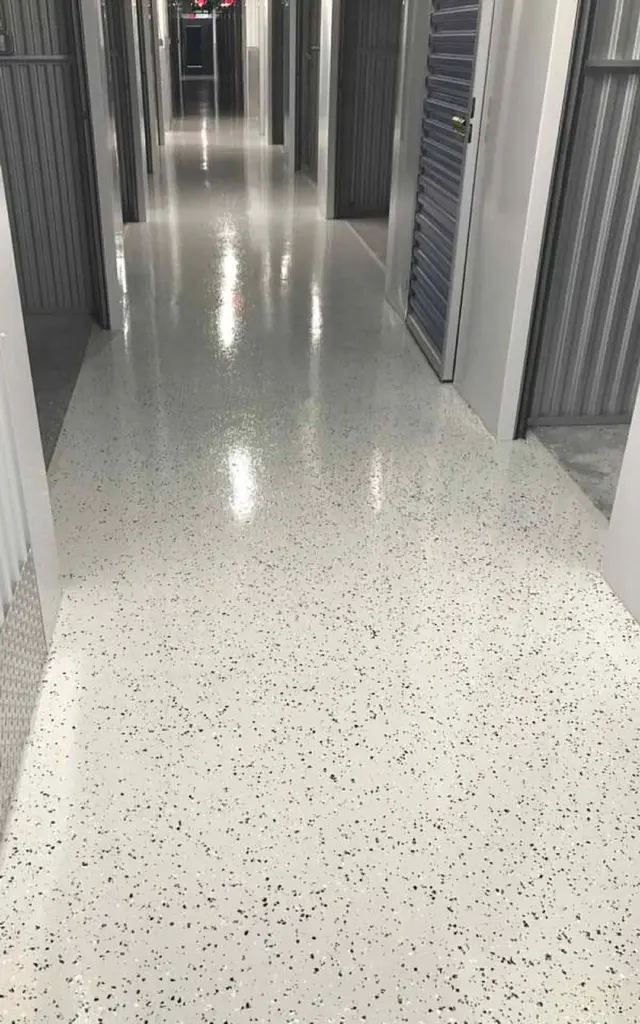
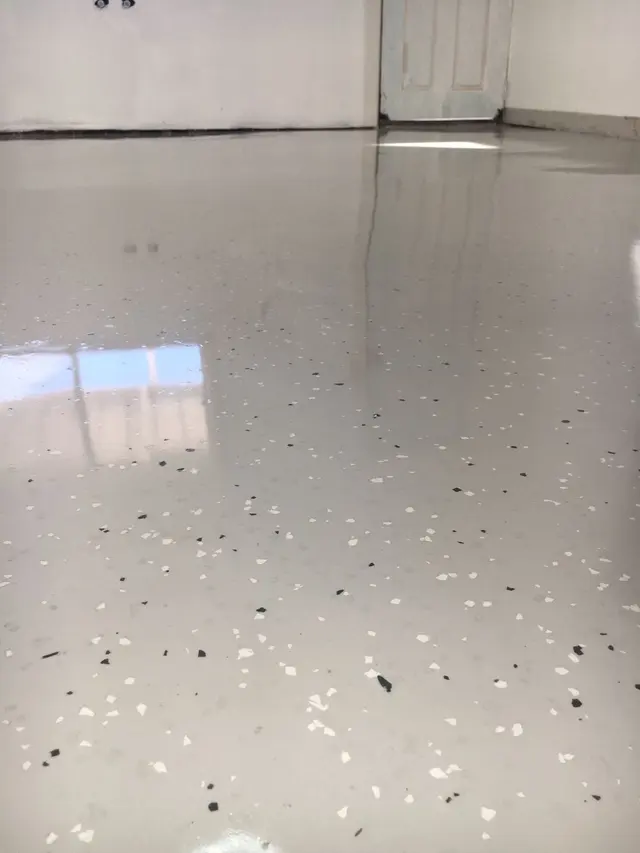
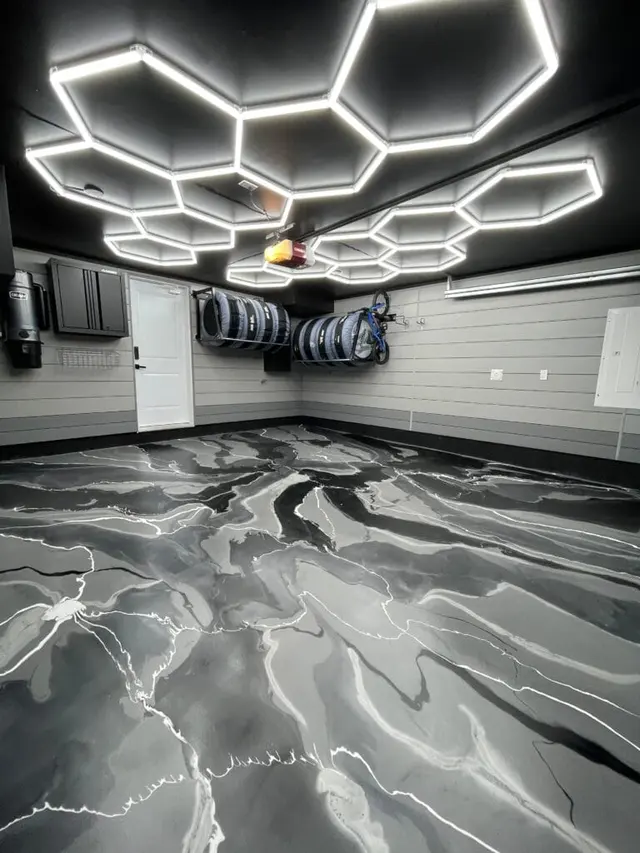
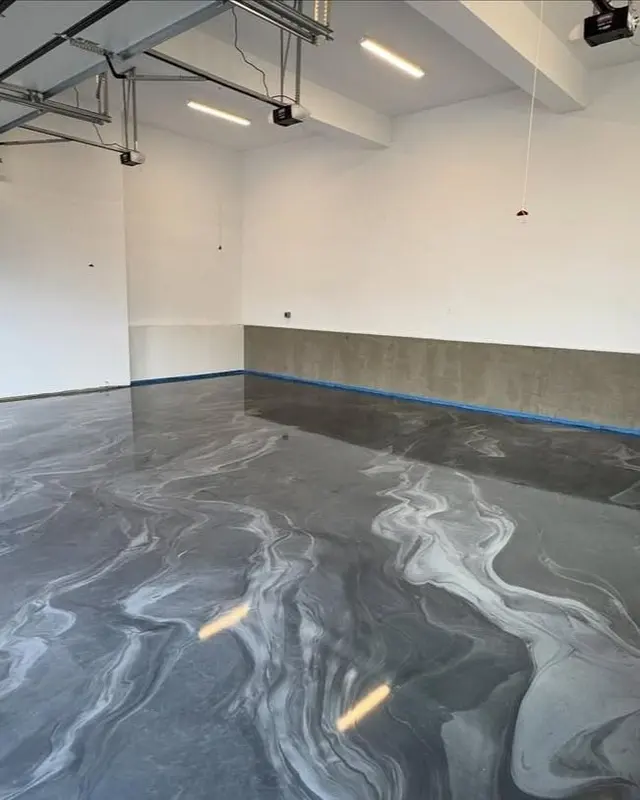
To see how a finished garage floor looks, have a look at the photos from our projects further down this page.
Pouring in winter and in an unheated garage
A cold garage is a problem for epoxy: both the air and the concrete must be at least +10 °C during pouring and curing. In the colder months the garage therefore has to be warmed up beforehand with electric heaters. According to the Sikafloor-264 technical data sheet, gas and oil heaters release water vapour and carbon dioxide into the air, which harm the surface.
The fresh layer has to stay dry for the first day: water must not get onto it, and in a cold garage condensation must not form on it. The cold also means a longer wait before the car can go back in.
- At +20 °C you can walk on the floor about 24 hours after the last coat, and it can take light loads after about 4 days. We recommend keeping the car out until the floor has fully cured, after about 7 days.
- At +10 °C it’s about 3 days until you can walk on it, 6 days until light loads and about 10 days before the car can go in.
Home garage or commercial garage and workshop
A home garage gets the same epoxy as a commercial one. We don’t pour epoxy in the living areas of a house, though: that’s the place for polyurethane, which is more flexible and more comfortable under bare feet.
In a commercial garage or workshop, the build-up depends on how the space is used: whether it has vehicle lifts, a service pit or a car-wash area. These cases are covered on the car workshop flooring page.
A commercial garage that can’t be closed all at once is done in parts, following the split agreed at the site survey. Working this way costs more than pouring in one go.