
For factories, production and logistics
Industrial
flooring.
A floor that stands up to forklifts, chemicals and three-shift operation.
Exact price after a site survey
A poured industrial floor is about the operation, not the looks: how many tonnes cross it every day, what gets spilt on it and how quickly it can go back into production after maintenance. That decides the system: epoxy, polyurethane, or a combination of the two with a quartz sand broadcast.
We only specify the build-up once the substrate has been assessed: we measure the moisture and check the strength of the substrate and the condition of the movement joints. Depending on the operation, we add an anti-static (ESD) layer, a dissipative layer for explosive atmospheres (ATEX), an anti-slip broadcast (the R rating is documented by the manufacturer’s test for that particular build-up) or a hygienic surface for food production.
Features
- Epoxy, polyurethane or a hybrid system
- 2–6 mm thick, depending on the load
- ESD, ATEX, anti-slip broadcast and hygienic surface to suit the operation
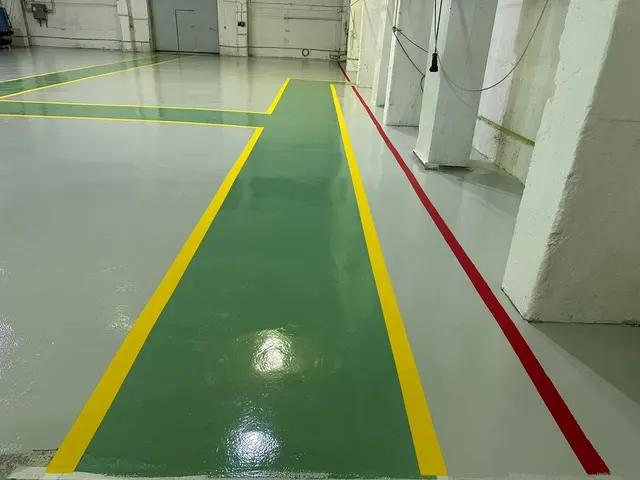
- Line marking and skirting
- Sequence and phasing agreed at the site survey
Specialist systems for industry
Where the floor has another job to do besides carrying the load: dissipating static charge (including in explosive atmospheres), reducing the risk of slipping or allowing hygienic cleaning. Each system’s page explains how it works, the standards behind it and the questions we’re asked most.
- ESDControlled static dissipation and protection for sensitive electronics. We design to EN IEC 61340-5-1.Price on request
- HACCPA seamless, easy-to-clean surface in line with the flooring requirements of Annex II to Regulation (EC) No 852/2004.Price on request
- ATEXA dissipative floor below 10⁸ Ω that, together with dissipative footwear, drains static charge from people in explosive atmospheres.Price on request
- Anti-slipWe recommend an R rating to suit your premises. Slip resistance is determined by the ramp test (DIN 51130 / DIN EN 16165).Price on request
- Car workshopA dust-free, washable surface with an anti-slip broadcast for repair areas, tyre shops, vehicle test centres, service pits and car wash bays.Price on request
Which system do you need?
A rough guide by environment. Each value is shown with the standard or rule it comes from. The specific requirement is set by the risk assessment for your site.
| Environment | System | Guide value | More about the system |
|---|---|---|---|
| Electronics manufacturing and assembly, server rooms | SystemESD flooring | Valueresistance to ground below 1 × 10⁹ ΩEN IEC 61340-5-1 | MoreESD flooring |
| Solvent store, paint shop, mill | SystemDissipative floor for explosive atmospheres (ATEX) | Valueleakage resistance below 10⁸ Ω (zones 0, 1, 20; zone 21 for sensitive dusts)TRGS 727, German technical rule | MoreFlooring for explosive atmospheres |
| Restaurant, hotel, hospital or large-scale kitchen | SystemHygienic floor with an anti-slip broadcast | ValueR12 ratingASR A1.5, German technical rule | MoreHygienic flooring for the food industry Anti-slip flooring |
| Milk processing (dairy) | SystemHygienic floor with an anti-slip broadcast | ValueR12 ratingASR A1.5, German technical rule | MoreHygienic flooring for the food industry Anti-slip flooring |
| Kitchen of a school, nursery or care home | SystemHygienic floor with an anti-slip broadcast | ValueR11 ratingASR A1.5, German technical rule | MoreHygienic flooring for the food industry Anti-slip flooring |
| Car workshop and vehicle repair shop | SystemAnti-slip flooring | ValueR11 rating; service pit R12 V4ASR A1.5, German technical rule | MoreCar workshop flooring |
ASR A1.5 and TRGS 727 are German technical rules. They are not binding in Slovakia; they are used as a recognised reference. What is binding is the operator’s risk assessment: for explosive atmospheres, the explosion protection document under Slovak Government Regulation No. 393/2006 Coll.; for workplace floors, the requirement for a non-slip surface in Slovak Government Regulation No. 391/2006 Coll.
Common combinations
- ESD and anti-slip
In electronics assembly, where the floor has to dissipate charge and must not be slippery. The resistance and the R rating both have to hold for the same build-up, so we choose it from the manufacturer’s test results.
- Hygienic floor and R11 or R12
In kitchens and food processing. A coarser broadcast grips better but is harder to clean, so we choose the rating to suit the site, not the highest one available.
- ATEX and chemical resistance
In solvent stores and paint shops the dissipative layer also has to withstand spills. We check resistance to specific chemicals in the manufacturer’s chemical resistance table.
Industrial epoxy, poured resin or concrete floor
An industrial concrete floor is the building’s concrete slab itself, which carries the load. A poured floor — in other words a resin floor — is a thin layer of epoxy or polyurethane that is poured onto the concrete and seals it. An industrial epoxy floor is a poured floor made of epoxy. We don’t cast new concrete slabs; we work on existing concrete.
Bare concrete can carry the load, but its surface is porous: it dusts under wheels, and oil or water soaks into it. Once it is sealed with resin, a spill stays on the surface, where it can be wiped up, and the floor can be machine-cleaned.
Epoxy is harder and more resistant to abrasion, which is why we pour it in factories, warehouses and workshops indoors. In direct sunlight it yellows over time, and its heat resistance is limited — no more than +50 °C continuously. Polyurethane is more flexible and isn’t bothered by sunlight or temperature swings, so it belongs outdoors and wherever the substrate moves slightly. A quartz broadcast — sand scattered into the resin while it is still soft — roughens the surface in wet and greasy areas. How a system is chosen for forklifts and racking is covered on our factory and warehouse flooring page.
Poured resin floor or PVC tiles for factories and warehouses
A poured layer bonds to the concrete across the whole area. PVC tiles are separate pieces that are either loose-laid with interlocking edges or glued down. Between the tiles there are joints where liquid can seep in and dirt can collect; a poured layer has none. If part of the building needs an anti-static ESD floor, a dissipative layer or an anti-slip finish, it is handled within the same poured build-up.
Tiles can be the more sensible choice in a rented unit you will move out of one day, because you can’t take a poured layer with you. The same goes for concrete so badly broken up that it would need extensive repair before pouring, when you need the floor sooner than that repair could be done.
Another difference is downtime: tiles don’t need to cure, a poured layer does. At +20 °C, Sikafloor-264 epoxy takes full load about a week after the final coat. That doesn’t mean shutting down the whole operation, though: the work is done in sections and the rest of the building keeps running in the meantime. Each additional phase does push the price up, because it means another visit by the crew.
Industrial floor repair and refurbishment
For us, repairing an industrial floor means a new poured layer of epoxy or polyurethane over the original concrete, with no breaking out. The condition is a dry, sound substrate: we don’t pour onto concrete with rising damp until its cause has been dealt with, and a thin layer won’t save a slab that is breaking up. An existing coating that is firmly bonded can stay as the substrate; anything that is flaking has to come off.
Oil-contaminated concrete is ground across the whole area and the most heavily soaked spots are milled. Sikafloor-60 Buster, applied repeatedly, helps draw the oil out of the pores. TopStone EP02 O primer, on the other hand, is designed for greasy substrates. We offer both products and make the choice after the site survey.
A structural movement joint has to keep working in the new layer too, so we fill it with a flexible sealant rather than resin. Construction joints and cracks that no longer move are treated with resin before priming. For us, grinding is preparation for the poured layer. What to watch out for with old floors in car workshops is covered on our car workshop flooring page.
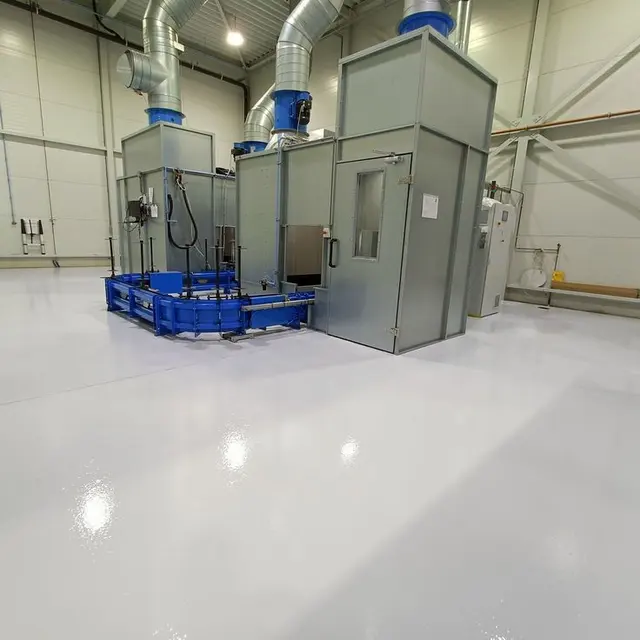
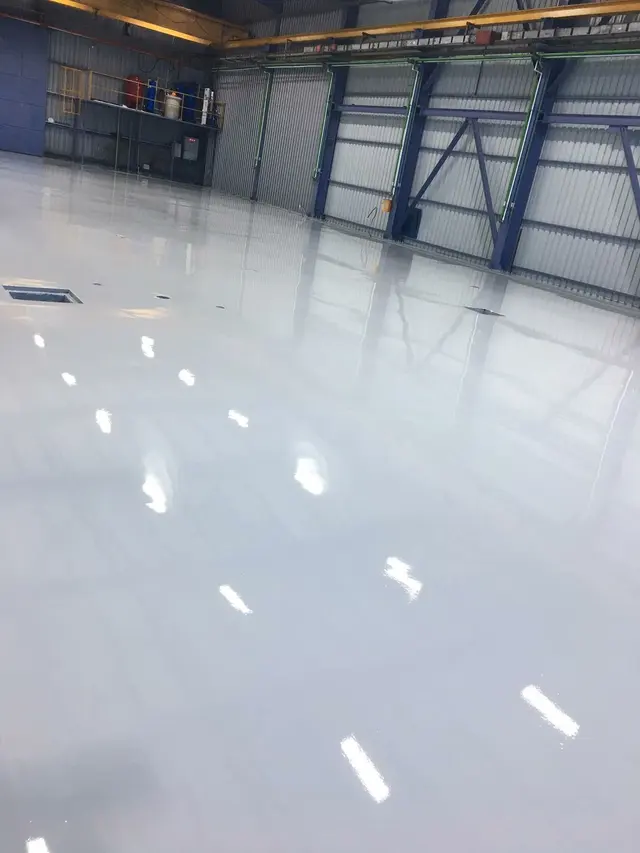
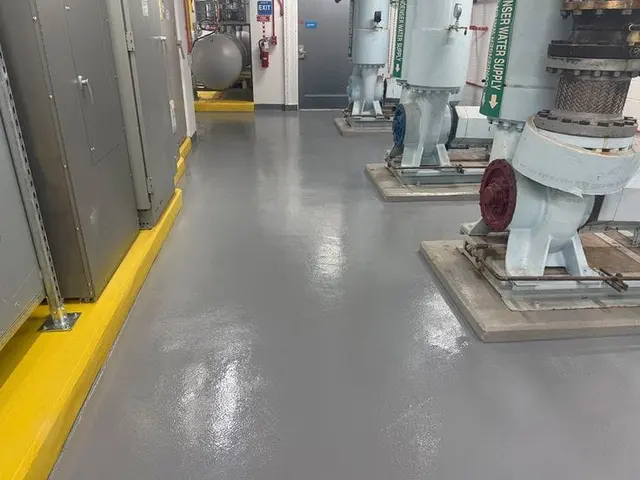
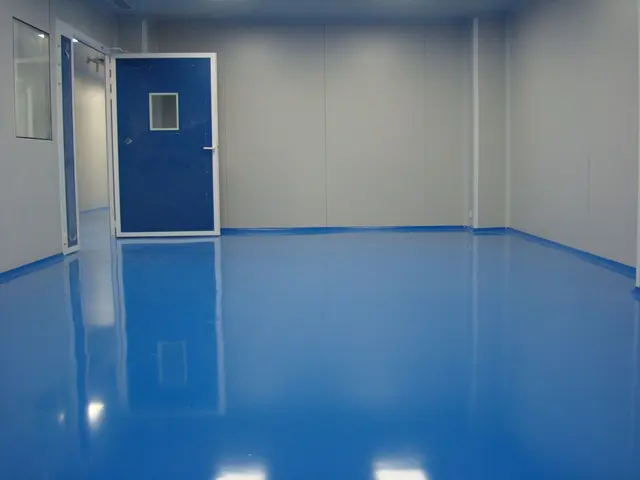
From our industrial projects
All projects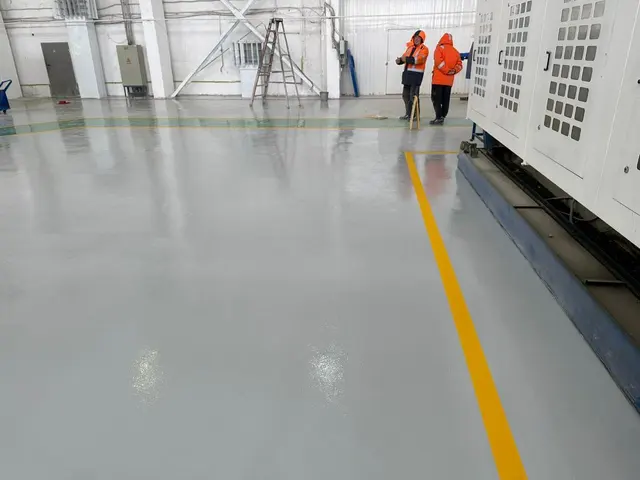
How we install an industrial floor
Step by step, including the waiting times between coats. This is the sequence that is actually followed on site.
Enquiry via the form
It all starts with the quote form. You give the floor area, the type of substrate and where the site is, because transport is added to the price. You describe the operation in your own words — for example, what runs on the floor and what might be spilt on it.
Site survey and concrete assessment
At the survey we measure the residual moisture of the concrete, which must not exceed 4–6% depending on the material used. We assess the strength and flatness of the substrate, map the movement joints and cracks, and look for greasy or crumbling areas. If the operation can’t stop, we agree the sections and their order. We only confirm the final build-up on the basis of these findings.
Substrate preparation
We grind the concrete with a diamond grinder with dust extraction and vacuum it, so that the primer bonds directly to it. Cracks and joints are treated according to their type; oil-contaminated areas are cleaned or milled off. More pronounced unevenness is corrected with a levelling compound 4 to 10 mm thick.
Sikafloor-151 primer
In the standard build-up we apply Sikafloor-151 primer resin to the prepared concrete at a rate of about 0.4 kg/m², and the next layer goes on after about 12 hours. From priming right through to full cure, both the air and the substrate need to be at least +10 °C, and the building may only be heated with electric heaters.
Sikafloor-264 main layer
The main layer is Sikafloor-264 epoxy applied in two coats, with an interval of at least 24 hours at +20 °C. Where needed, we broadcast quartz sand into the second coat while it is still wet. The build-up for workshops and garages comes to about 1 mm in total; for heavier loads we choose a thicker one. On an ESD floor, copper tapes are stuck to the primer, covered with a conductive intermediate coat and finished with the ESD layer. On a dissipative ATEX floor, the tapes connect the dissipative layer to the earthing points.
Curing and loading
Three waiting times run from the final coat. At +20 °C you need to wait about 24 hours before walking on it, 4 days for light traffic and 7 days for full load; at +10 °C it is 3, 6 and 10 days. For the first day after application the surface must be protected from water and from condensation.
Maintaining the finished floor
Wipe up spills as soon as possible — with prolonged contact the surface is less resistant. A machine with rotary brushes or a pressure washer is fine for cleaning, but choose the detergent in line with the flooring manufacturer’s instructions. With an anti-slip surface this matters all the more, because an unsuitable product can reduce its effect.
Frequently asked questions
Industrial flooring: the questions we’re asked most often.
When do I need a specialist system rather than a standard industrial floor?
What do you need to know to prepare a quote?
Can the floor be done in sections so the operation doesn’t have to stop?
How is the price of an industrial floor worked out?
How thick is an industrial floor and what is it made up of?
What load can an industrial floor take?
When can the floor be walked on, and when can it take load?
How long does an industrial floor last?
Want to know what it will cost?
The price depends mainly on the condition of the substrate, the area and the system chosen. Send us a no-obligation enquiry.